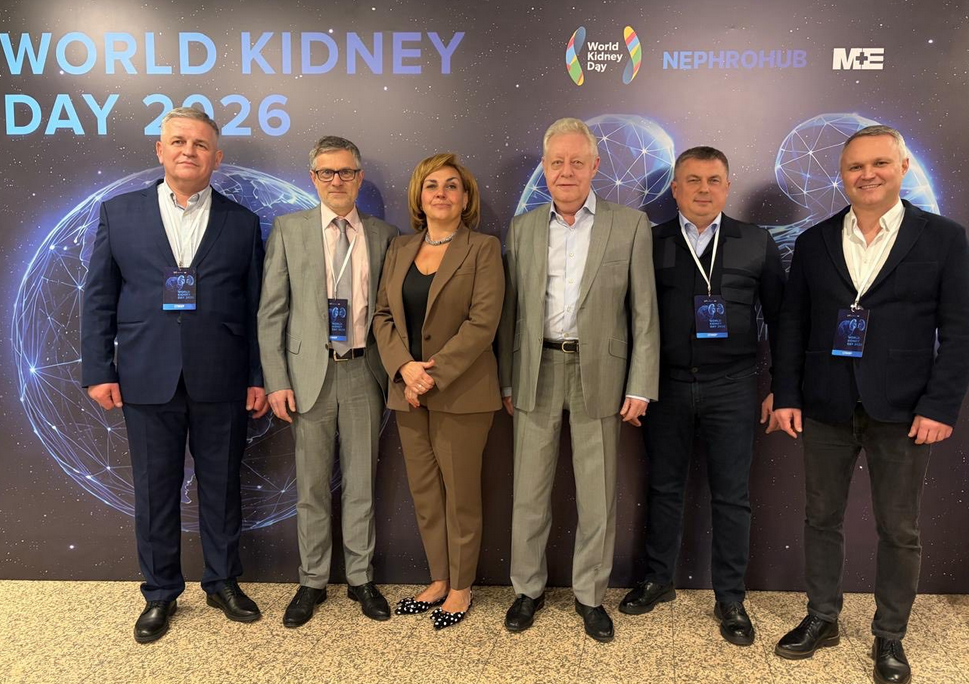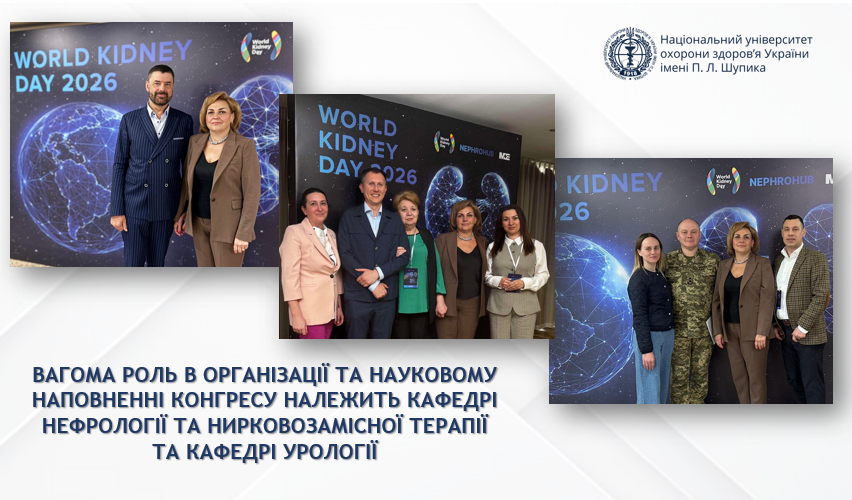

On April 2–3, 2026, Kyiv hosted the World Kidney Day 2026 Congress at Premier Hotel Rus in a hybrid format, both onsite and online. The scale of the event was reflected in its broad professional audience, which included nephrologists, urologists, rheumatologists, obstetricians and gynecologists, transplant specialists, cardiologists, clinical laboratory diagnostics professionals, and many other healthcare experts. The event was internationally accredited by ACCME.
A major contribution to the organization and scientific content of the Congress was made by the Department of Nephrology and Renal Replacement Therapy, the Department of Urology of Shupyk National Healthcare University of Ukraine, the State Institution “Academician O. F. Vozianov Institute of Urology of the National Academy of Medical Sciences of Ukraine,” the Ukrainian Association of Urologists, the Medical Forces Command of the Armed Forces of Ukraine, and the National Military Medical Clinical Center “Main Military Clinical Hospital” of the Ministry of Defense of Ukraine.
A dedicated part of the Congress focused on military medicine in contemporary conditions. This section addressed the specific features of medical support for the Armed Forces of Ukraine in the context of full-scale military aggression, as well as current challenges and future directions for the development of the military medical system.
The scientific program also covered key interdisciplinary areas of modern nephrology and urology. One of the central thematic tracks was the rheumatology-nephrology alliance, which featured discussions on lupus nephritis in light of the updated EULAR recommendations, antiphospholipid syndrome, scleroderma renal crisis, the combination of hyperuricemia, gout, and chronic kidney disease, as well as practical approaches to the treatment of systemic ANCA-associated vasculitis. A separate section of the program was devoted to kidney health and pregnancy, ranging from modern prenatal diagnosis of congenital anomalies of the fetal urinary system to the challenges of pregnancy in kidney transplant recipients and current approaches to the management of such patients.
Particular attention was drawn to review lectures dedicated to major international scientific events of 2026. The program included a special session, “Highlights from the World Congress of Nephrology WCN 2026: From Today’s Realities to Future Perspectives,” as well as the urology block, “Updates from the 2026 Congress of the European Association of Urology,” which addressed the latest EAU 2026 updates on urinary tract infections, urolithiasis, nephron-sparing surgery, and metaphylaxis of calcium oxalate nephrolithiasis.
The World Kidney Day 2026 Congress reaffirmed the role of Shupyk National Healthcare University of Ukraine as one of the leading centers of postgraduate medical education, scientific communication, and interdisciplinary cooperation in nephrology and urology. The combination of timely clinical topics, an international perspective, a broad network of scientific partners, and the active involvement of university representatives made this event an important platform for professional exchange and for bringing modern knowledge into clinical practice.