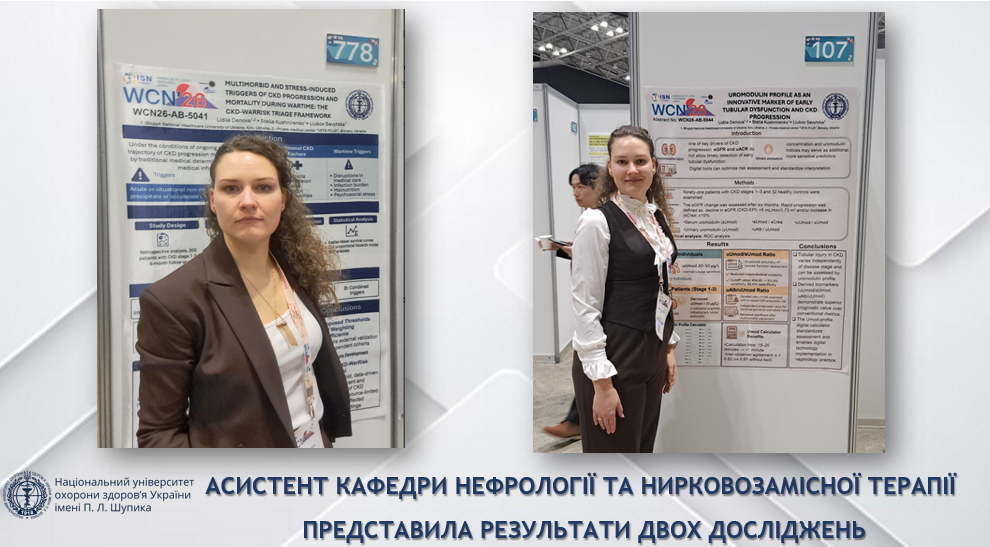
From March 28 to 31, 2026, the World Congress of Nephrology 2026 (WCN 2026) took place in Yokohama, Japan—one of the leading global forums in the field of nephrology. According to the organizers, more than 3,000 abstracts were submitted by specialists from around the world, underscoring both the high scientific standards of the selection process and the truly international scale of the Congress.
At this prestigious international event, Liubov Savytska, MD, PhD, Assistant Professor at the Department of Nephrology and Renal Replacement Therapy at Shupyk National Healthcare University of Ukraine, presented the results of two studies: “Uromodulin profile as an innovative marker of early tubular dysfunction and ckd progression” and “Multimorbid and stress-induced triggers of ckd progression and mortality during wartime: the ckd-warrisk triage framework.”
The high relevance of these studies was reflected in their inclusion in thematic tracks directly aligned with current priorities in global nephrology, including the diagnosis, classification, and progression of chronic kidney disease, as well as the specific challenges of CKD burden and management in countries operating under resource constraints and crisis conditions. In this way, the presented research was fully integrated into the international scientific agenda of WCN 2026.
Of particular importance was the poster presentation devoted to CKD progression and mortality during wartime. For contemporary nephrology, this area is of exceptional practical significance: existing publications show that war and other crises disrupt continuity of care, medical logistics, access to treatment, and overall delivery of nephrology services. At the same time, the Ukrainian experience is already offering valuable lessons for the global nephrology community and may help improve patient care in conflict-affected settings. For this reason, the Ukrainian approach presented at WCN 2026 to assessing triggers of CKD progression during wartime may serve as a promising foundation for the development of clinical algorithms and for improving patient outcomes not only in Ukraine, but also in other countries facing humanitarian crises.
Thus, the presentation of the Department’s research findings at the World Congress of Nephrology 2026 was not only evidence of the high scientific standing of the nephrology school of Shupyk National Healthcare University of Ukraine, but also an important step toward the further integration of Ukrainian research into the international scientific community.